
25 de August de 2026
How can we ensure that continuing education transforms children’s learning? This question guides all of LabEdu’s work, which is why monitoring is a structural component of our programs. See below the highlights of the implementation of teacher and administrator training in six municipalities in Portal do Sertão, Bahia, based on data collected from classroom observations.
Since the beginning of the year, 306 professionals have participated in the training sessions, including teachers, pedagogical coordinators, principals, and pedagogical coordinators, totaling 45 meetings and 176 hours of collaborative work.
The project began in 2025, when the municipalities of Água Fria, Antônio Cardoso, Conceição da Feira, Conceição do Jacuípe, Ipecaetá, and Irará underwent a participatory diagnostic process that guided the design of the strategies initiated this year. This year, the training pathway is based on the Learning to Study Texts methodology, which has already been implemented in different contexts, from the metropolitan region of São Paulo to the interior of Maranhão, with proven effectiveness in research and impact evaluation studies.
The monitoring data, produced from 86 observations of reading activities in the classroom, conducted in 45 schools—more than half of the schools mapped by the project—show important actions supporting reader development being incorporated into practice.
Before the training sessions, the interventions that teachers conducted before reading were limited to presenting the text’s theme to the children (50% of observed classes). Throughout the cycles, they expanded this repertoire: today they draw attention to textual clues in 85% of the activities observed, propose hypothesis generation in 88%, and listen to students’ contributions to connect them to what they expect to discover in the reading in 68%. During reading, the movement is the same. Reading aloud by the teacher, present in half of the activities at the beginning, now occurs in all of them and in a more qualified manner: the intentional use of gestures and intonation reaches 82%.
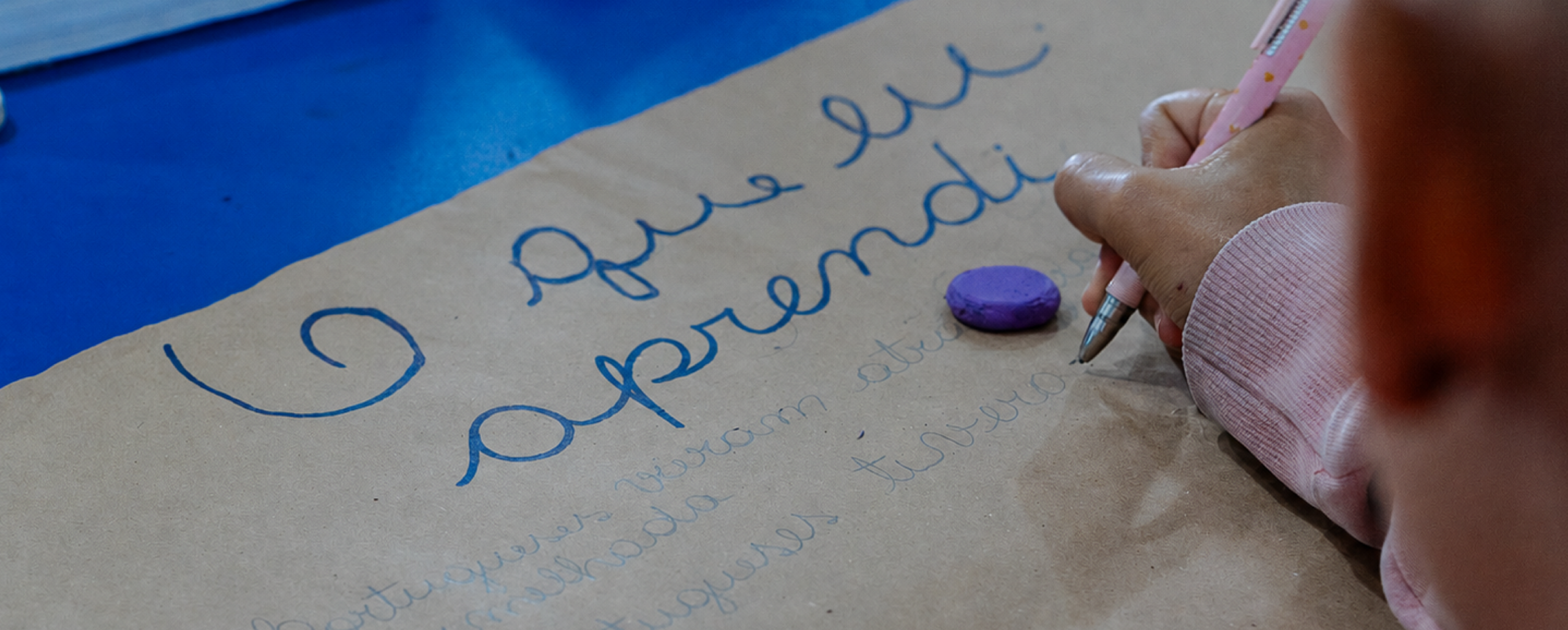
Behind these numbers is the experience of teacher Marli Mata, from the Pindobas Municipal School in Conceição do Jacuípe. This month, during a round of meetings to review activities with educators and students, she reported the changes she has noticed in her own professional development and in the children’s learning. The teacher explained that at the beginning the challenge was significant: what was discussed in the training seemed distant from what could happen inside the classroom. However, with the very first text worked on, she was struck by the students’ engagement, as they asked to repeat the activity several times.
The experience also revealed the potential of the Learning to Study Texts training methodology beyond the History discipline, which is the focus of the approach. According to Marli, the results became even clearer through contrast. When conducting an activity with other material and noticing the students’ difficulty and lack of interest, the teacher decided to apply the strategies learned in the training.
“That’s when the idea came to us to use this method from the History texts to work on the environment, so that something interesting could emerge from it, because the students weren’t interested in simply producing a text on the topic. That’s when we had this insight to return to these strategies we’re learning here in the course. And then we saw that it really improved a lot.”
The semester continues with the remaining training cycles and classroom observations, in addition to closing meetings that will bring together teachers, coordinators, and principals from the six municipalities to consolidate the year’s learning. The initiative, which has a four-year duration, is supported by the Maria Emília Foundation.