14 de July de 2026
Brazilians’ reading habits were the subject of the Retratos da Leitura survey, recently released by the Instituto Pró-Livro. The survey found that most Brazilians (53%) had not read even part of a book in the three months prior to the question, which is considered a non-reader profile. This is the worst result since 2007, when the survey began. The project Aprender: Dentro e Fora da Escola, currently being implemented by Labedu in the 217 municipalities of Maranhão in partnership with the State Department of Education (Seduc/MA), aims to address this reality by strengthening the reading development of educators and of children from zero to five years old.
We spoke with Cecília Diniz, a researcher in Sociology of Education and a Labedu trainer, to understand how the project’s methodology and the coordination of actions in partnership with the public sector help promote reading in territories often marked by social inequality.
Looking at the survey results, the data on influence and reading development are particularly striking. Comparing those considered readers, we see an important difference of almost 20 percentage points: 46% of children who are readers had someone read to them, while only 28% of non-readers had the same. It seems somewhat obvious to say that a caregiver’s habit of reading to a child will positively impact their development as a reader, but how can the school influence this process at home?
When we began implementing Aprender in 2019, we saw that reading to children was not a habit in Early Childhood Education, which is the project’s focus. It happened, but it was very rare. They had very small collections, or even where there were more books, they were not read to the children. They did not understand that this was something important to do, or they did storytelling, which is different from reading. And even then, it was not part of the daily routine. Since then, the project’s work has focused on strengthening the practice of daily reading aloud by the teacher, promoting a consistent closeness between children and books. If all teachers read to children every day, that would already be a huge step forward!
We also work with principals to strengthen and establish projects that promote book lending, so that children can take copies home. So even if they do not have books at home due to lack of resources, the Early Childhood Education institution lends them so there can be a moment together with the family. In this way, we help strengthen this partnership between the institution and families.
Labedu’s work is very much grounded in this pairing, right? It is the motto “every child can learn and every adult educates,” it is the very name of the project “inside and outside school.” It is very important to take care of both aspects. Even though our direct relationship is with Early Childhood Education, we think about actions that can resonate within the family, to create a partnership between families and Early Childhood Education.
How are teachers’ training sessions designed to ensure not only the presence of reading, but high-quality reading? How do you train those who train readers?
An important piece of data to understand this issue emerged during the territory diagnostic phase. As we went along, we saw that the teachers and coordinators themselves were often not readers. They also did not have this reading development, which appears in the results of Retratos da Leitura. So, in the first phase of the project, we did very important work on the reading development of the education professionals who would read to the children. Because the person who is going to read to a child needs to agree that this is important, that it is not an extra activity to be done when other resources have run out, or when there is time left over.
So, we worked by training the coordinators so that they could train the teachers. We focused mainly on literary reading, which is an experience of contact with the text—of recalling things, what you feel, what you think from that text… And then the issue of unequal access comes in. Someone who did not have good reading development will hardly be able to develop readers, whether their children or their students. The result of this work with educators was a strong appreciation of reading. After reading a short story in the training, many would come and say they had read the whole book afterwards, for example.
And the teachers’ training is done with literature for adults, right?
Exactly, so that they develop as readers, value it, and can bring that into practice. Because we believe it is difficult for someone who is not a reader—who does not see value in it because they do not have that prior experience—to be able to mediate reading well, to truly understand how transformative it is and, in fact, fight to ensure there is reading every day in the institution where they work.
Why is storytelling not the same as reading to children?
We saw a lot, at the beginning, the two things being confused. And for many reasons. Sometimes due to lack of access to books, or because they think young children do not pay attention to reading, or because they believe storytelling will capture the little ones’ attention more. It was also very common for teachers to do a dramatization, like making puppets of the story’s characters, or dressing up to act it out. The problem is that all of this ends up complicating the activity. The time it takes to make the puppets or set up the scenery makes it unfeasible to do every day. You will do that once a month, right? For reading, on the other hand, all you need is a good book. You just need to read it beforehand, prepare, and read to the children.
In addition, with reading you are putting children in contact with written language. The organization of written text is different, even when it is read aloud. And it also provides familiarity with the book as an object. If we want children to be interested in reading, they need to be in contact with this book object. It is not only the text, only the story; it is the illustrations, the interactions that many authors create between illustration and text… Looking at all these elements develops other skills of reading behavior that storytelling does not foster.
I am not saying that storytelling is not important, but what we need to ensure every day is the reading of texts. It is letting children handle books, while teaching them how to handle them with care. That is why, if we want them to be enchanted by books, they need to be able to handle these books, live with them, with an adult there guiding and reading to them. All of this has been content in our training sessions.
And what is the role of project monitoring, this follow-up that Labedu does to adjust the training sessions?
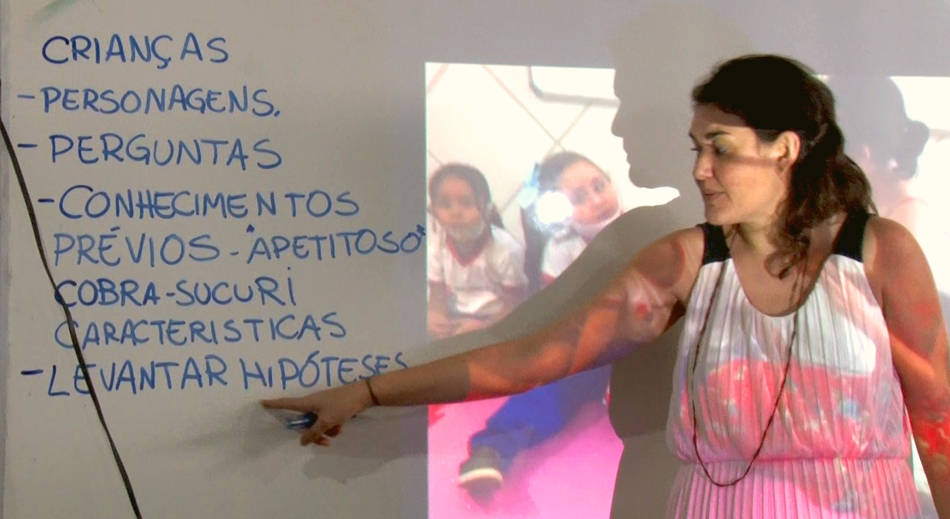
It is fundamental. It is not just about doing the training and thinking the mission is accomplished. We go into the field to observe teachers reading, how they are doing it. Whether they have been able to read or are still storytelling, or retelling the story with the book in hand. How do I guide this teacher? It is the monitoring work that feeds back into the training. With this, we can see what the challenges of practice are and make adjustments.
Returning to the issue of developing readers, it benefits not only learning, but children’s full development, right?
You brought up something very, very important. There is a mistaken idea that you read to teach children something. In the training sessions, we work with the idea that we read so that children can have the experience with the book, the encounter with the text. In Early Childhood Education, we read to broaden their understanding of the world, their vocabulary, and children’s relationship with language.
In the later stages of school life, everything will depend on this understanding of reading that is built in Early Childhood Education, which is not about reading only to decode. It is not reading to understand letters and form words. It is reading in the sense of reading the world, of understanding and relating to that text, of creating meaning for what is being said.
The survey points to a peak in the proportion of readers between 11 and 13 years old, and then that number progressively falls—meaning Brazilians stop reading over the course of their lives. Why do you think this happens?
With frequent reading done or recommended by teachers, it is possible to build a reading community in Early Childhood Education and in Elementary School. When we read a book and propose that everyone talk about that book—about what they felt, what they thought, what it reminded them of… I think that in adult life we may become discouraged from reading and let it go due to the lack of participation in a community of readers. Because having someone to exchange with, someone to talk about books with, is very important. If people are talking about a certain book, I feel like reading it. The school can build this, right? Because you read the same text to all the children and they can comment on the reading, or when children are a bit older they start recommending the books they have read. So the school also has this important role in helping build this reading community. The question is whether it is or is not being that community, right? But it also has this role of building this reading environment.
Learn more:
Article shares an experience report on Labedu’s project in Maranhão
Access here the 6th edition of Retratos da Leitura no Brasil